
Archy Dental Software
Archy Dental Software is the kind of platform that immediately makes sense once you see how fragmented a typical dental tech stack has become. Instead of forcing practices to juggle separate tools for scheduling, imaging, texting, payments, insurance, and reporting, Archy positions itself as a single cloud-based system built to run the entire practice from one place.
General Definition and Category
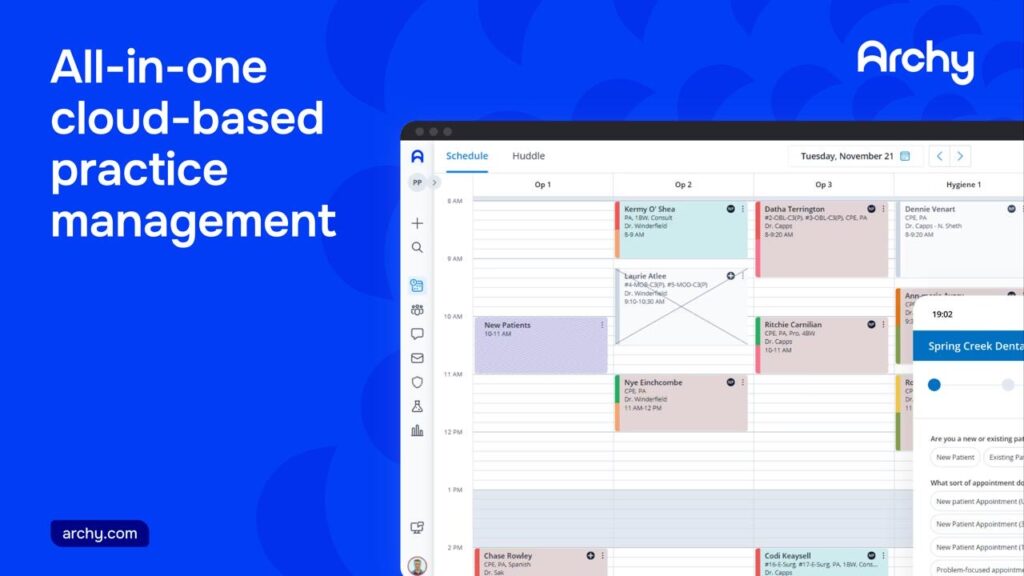
At its core, Archy dental software belongs to the modern category of cloud-native systems built to unify the operational, financial, and clinical layers of a dental office inside one connected environment.
Rather than treating scheduling, billing, imaging, forms, insurance, and patient messaging as separate tools linked through fragile integrations, Archy is positioned as a single platform designed to centralize data objects, reduce duplicate entry, and keep front-desk workflows, provider documentation, and revenue-cycle tasks synchronized in real time.
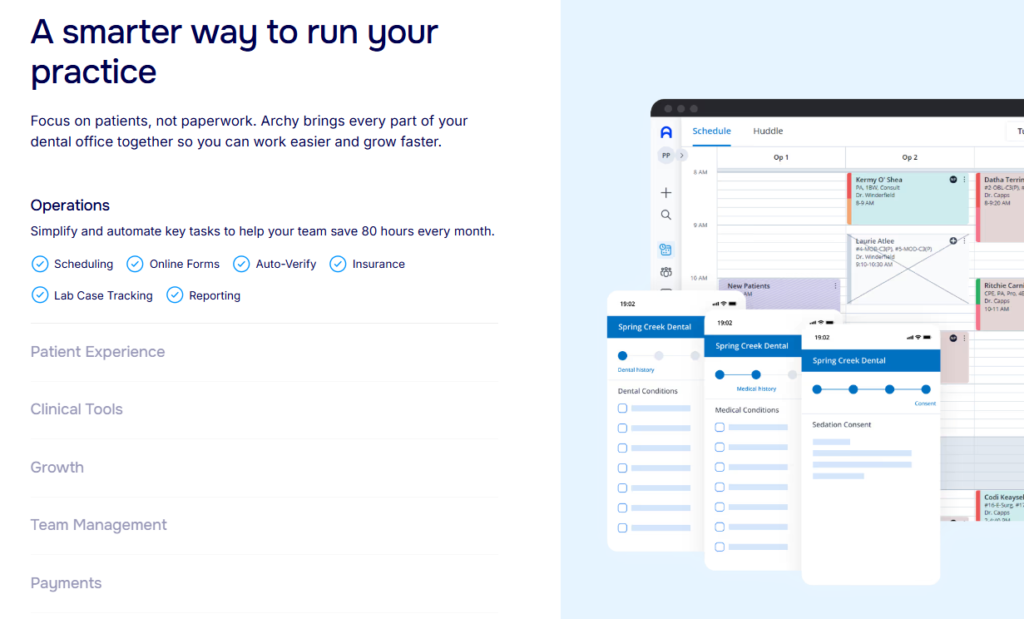
On its official site, the company describes the product as software intended to replace multiple point solutions with one platform spanning patient care, communication, reporting, and imaging.
From a systems perspective, Archy dental practice management software sits in the practice-management layer of the dental technology stack, but it stretches beyond the narrow legacy meaning of “practice management.” Traditional PMS products were often centered on appointment books, ledger functions, and insurance claims, with newer capabilities added through modules or third-party tools.
Archy’s positioning is broader: operations, patient experience, payments, reporting, and clinical workflows are presented as parts of one shared architecture. That matters technically because a unified data model can reduce reconciliation errors between administrative and clinical records, simplify permissioning, and make workflow automation more reliable across the patient lifecycle, from intake to claim submission to follow-up communication.
The phrase Archy cloud dental software is especially important because the cloud model is not just a hosting choice; it changes how a practice deploys, maintains, and scales software. Archy explicitly markets the platform as cloud-based and also publishes materials arguing that dental practices no longer need on-premise servers for core software operations. In practical terms, that usually means browser-based access, centralized updates, lower local infrastructure dependency, easier multi-site coordination, and a reduced need for office-level server administration.
For U.S. dental groups and growing practices, this architecture can be strategically valuable because it supports distributed access, more standardized workflows, and faster rollout of new functionality without the version fragmentation that has historically affected server-based systems.
The label Archy all in one dental software reflects the product’s strongest category signal in the U.S. market: consolidation. Review platforms and vendor descriptions consistently frame Archy as a unified system that brings together scheduling, patient communications, insurance verification, charting, payments, reporting, and imaging in one interface.
That “all-in-one” position is commercially significant because many dental practices still operate with fragmented stacks in which communication, imaging, claims, and payments live in separate applications. A consolidated platform can improve usability, shorten staff training curves, and reduce operational drag caused by repeated handoffs between disconnected systems.
It also gives the vendor a stronger foundation for analytics and workflow orchestration because more of the practice’s activity exists inside one application layer.
The emerging category term AI dental software also applies here, especially after Archy introduced Archy Intelligence and expanded AI-driven functionality in workflow-heavy areas such as billing, charting, reporting, staffing support, and insurance-related tasks. In addition, Archy’s clinical tools page says FDA-cleared Pearl AI is available within its imaging suite for pathology support and calibrated bone-level analysis.
Technically, this places Archy in a newer class of dental software platforms that are not only cloud-based and integrated, but also beginning to embed task-specific AI agents and diagnostic-assist capabilities directly into the same operational environment.
That shift is important because it moves AI from an isolated add-on into the daily transaction layer of the practice, where it can influence documentation speed, administrative throughput, and decision support inside existing workflows rather than outside them.
Core Value Proposition
The real promise behind Archy is not simply that it runs in a browser, but that it re-architects the dental office around a unified, continuously connected operating layer. In that sense, cloud based dental practice management means more than remote access.
It means the scheduling engine, patient records, insurance workflows, reporting stack, communication tools, and clinical functions are designed to operate from the same live system rather than passing information through a chain of separate products and delayed syncs.
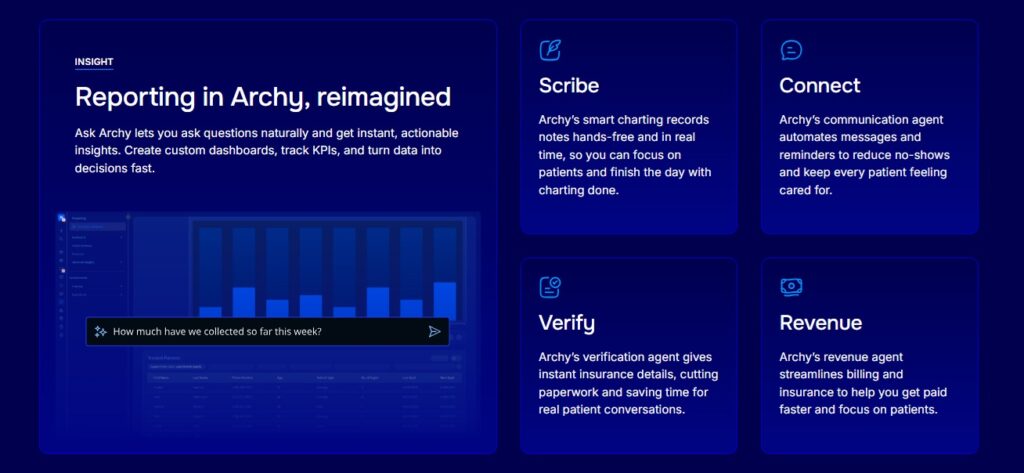
Archy presents this as a platform that replaces five or more tools with one cloud system, while third-party software directories describe it similarly as a unified environment for scheduling, charting, communications, insurance verification, and payments.
That is why the phrase all in one dental software fits the platform so well. In practical terms, consolidation reduces context switching for staff, lowers the probability of duplicate data entry, and improves process integrity across the front desk, clinical rooms, and billing office. When one system owns the appointment book, online forms, imaging access, claims flow, and financial records, the practice gains tighter control over throughput and fewer operational gaps between departments.
Archy’s own materials emphasize this replacement model, and customer-facing review content echoes the same idea by framing the product as a modern substitute for a fragmented legacy stack.
One of the most concrete value points is dental software without servers. Archy explicitly markets the platform as eliminating the need for local server infrastructure, and its onboarding materials reinforce that message by promising quick setup with no server requirement. Technically, that matters because on-premise dental software has historically forced practices to manage hardware lifecycle, local backups, version control, patching windows, and recovery planning at the office level.
A serverless office model reduces that administrative burden and shifts resilience toward vendor-managed cloud infrastructure. Archy’s cloud materials further state that the platform is hosted on Amazon Web Services and that data is stored across multiple locations, which strengthens the argument for operational continuity and disaster tolerance in U.S. practices that want less dependency on in-office hardware.
Security is another core layer of the product’s value proposition, especially for a category that handles protected health information, treatment records, payment data, and internal team communication. Archy describes its environment as HIPAA compliant dental software, and its public cloud materials add specifics such as intrusion detection, encryption, and certifications including ISO 9001 and SSAE 18. Its team-management materials also describe integrated HIPAA-compliant chat functionality.
From a technical governance standpoint, this matters because compliance in dental software is not only about encrypted storage; it also includes access control, controlled communication channels, auditable workflows, and an infrastructure posture that reduces the risk surface created by scattered tools and informal messaging.
The platform story also extends well to multi location dental software. Although Archy’s headline messaging is broad enough for single-site offices, the architecture it promotes is naturally aligned with multi-location operations because cloud delivery and a shared operating system make standardization easier across sites.
In a multi-office environment, the biggest technical challenges are usually consistency of workflows, centralized visibility, role-based access across teams, and reporting that is trustworthy at both local and organizational levels. Because Archy combines operational tools, patient communication, reporting, and team-management functions in the same platform, it is better positioned than disconnected systems to support cross-location governance without forcing offices to manage multiple products and multiple admin layers. This is partly an inference from the platform design Archy describes publicly, but it is a grounded one.
Taken together, the strongest Archy dental software features are not isolated checkboxes but the way they are structurally connected. Archy publicly highlights integrated scheduling, online forms, insurance workflows, reporting, clinical tools, patient communication, time tracking, online booking, and analytics across multiple platform pages.
The technical significance is that each feature becomes more valuable when it shares state with the others. Online booking can update the live schedule immediately; forms can flow into patient records; verification can support billing readiness; reporting can draw from the same system of record; and staff tools can operate without separate logins or disconnected utilities. That is the deeper value proposition: not just more features, but fewer seams between them.
Operations and Workflow
If the first two sections explain what Archy is and why its architecture matters, this section shows how that value appears in day-to-day execution. In operational terms, Archy is designed to reduce the handoff friction that usually slows a dental practice down: forms are collected before the visit, schedules stay current, lab work is easier to monitor, and reporting is built into the same system that generates the underlying activity data.
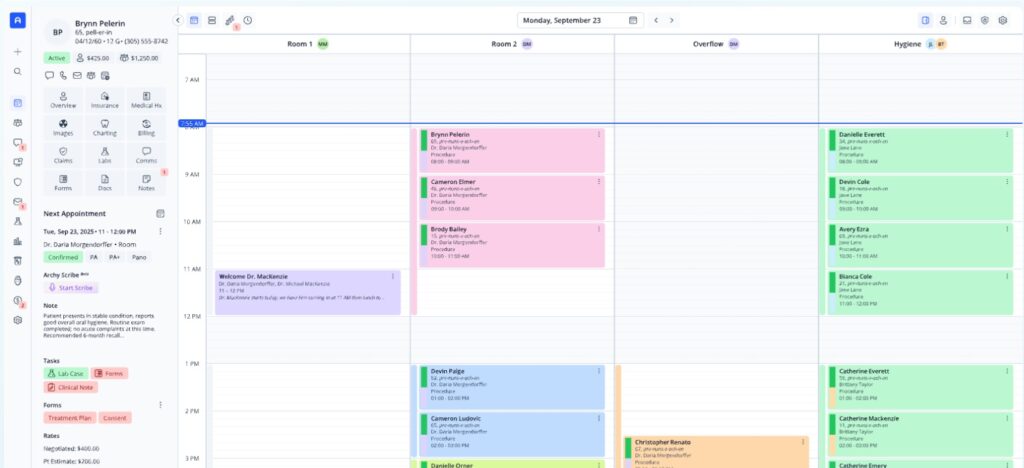
Archy’s public platform pages present operations as a connected workflow layer that includes scheduling, online forms, insurance processes, lab case tracking, and reporting, rather than a set of separate utilities.
A major part of that operating model is dental scheduling and online forms. Archy places both functions inside its operations stack and also connects them to growth and onboarding workflows, where provider schedules, reminders, and booking options are configured as part of system setup. This matters because scheduling works best when it is not isolated.
In a modern practice, the appointment record is not just a time slot; it is the trigger point for reminders, intake completion, treatment readiness, claim preparation, and downstream reporting. Archy’s own materials frame these functions as part of one continuous workflow, which suggests a system designed to reduce manual reconciliation between front-desk intake and the rest of the patient journey.
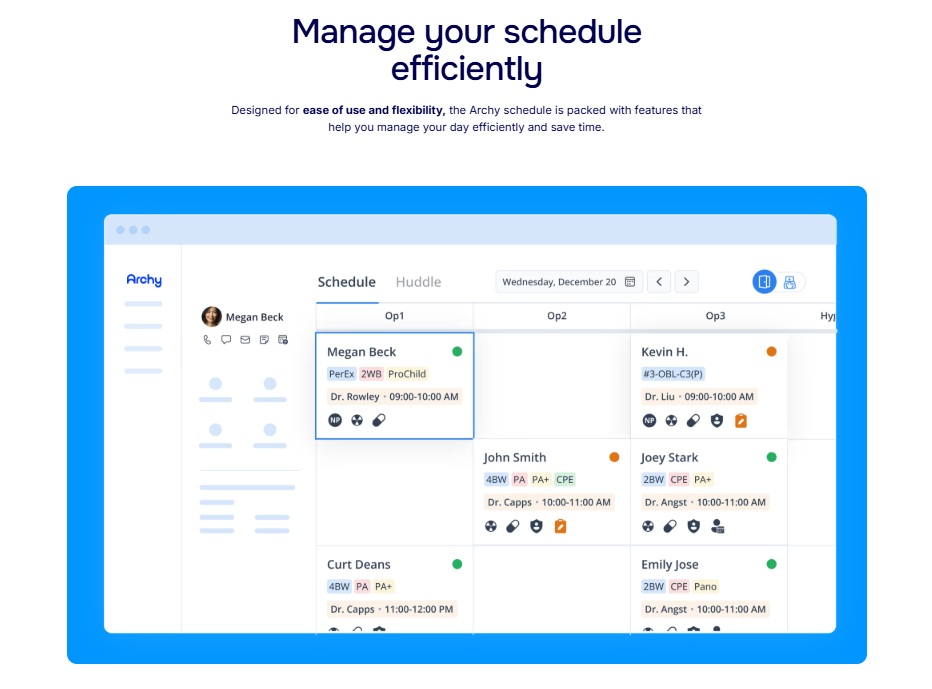
More specifically, dental scheduling software inside Archy appears to be built around real-time coordination rather than delayed synchronization. On the growth page, Archy says online scheduling is directly integrated and updates instantly in real time, without third-party syncing. That is a technically meaningful distinction.
In many dental environments, scheduling breaks down when external booking tools operate on lagging data or when staff must re-enter appointments manually. A real-time scheduling layer lowers double-booking risk, reduces phone traffic, and preserves schedule integrity across operatories, providers, and patient-facing booking channels.
Archy also claims practices using its online scheduling tools see 15 to 25 new online bookings monthly, with 45% of online bookings happening after 8 p.m., reinforcing the operational value of keeping scheduling live beyond office hours.
The intake side is supported by online dental forms, which Archy includes in both its operations and pricing materials. From a workflow engineering perspective, digital forms are most valuable when they do not stop at data capture. Their real benefit comes when submitted information can be standardized, attached to the right patient context, and made available to administrative and clinical users without duplicate entry.
Archy’s onboarding materials also mention custom forms and consent forms, which indicates the platform supports practice-specific intake design rather than a one-size-fits-all template approach. For a U.S. dental office, that helps create a cleaner pre-visit pipeline: collect data earlier, reduce paper handling, improve front-desk throughput, and prepare records before chair time begins.
Another operational feature with practical importance is lab case tracking. Archy lists this directly in its operations and pricing materials, which positions it as part of the daily coordination layer rather than an afterthought.
In practice, lab work often introduces hidden failure points: missing due dates, unclear status visibility, dependence on sticky notes or side spreadsheets, and weak coordination between clinical and administrative teams. When lab case management is housed inside the same platform that holds appointment and treatment context, the office gains better continuity.
It becomes easier to align restorative timelines, monitor external dependencies, and keep teams informed without relying on disconnected manual systems. Archy’s public descriptions do not expose every technical detail of the workflow model, but the inclusion of lab case tracking in the core product strongly implies an attempt to operationalize case visibility within the central platform.
Decision support is anchored by Archy dental reporting software, which Archy presents as more than static reporting. Its operations page highlights personalized dashboards and tailored reports, while a recent company post on Archy Intelligence and reimagined reporting emphasizes access to dashboards directly inside the platform, without requiring separate tools. From a technical standpoint, embedded reporting is much stronger than exported or bolt-on analytics because it works against the platform’s native data model.
That reduces delays, reduces transformation errors, and lets users move from insight to action more quickly. When reporting sits inside the same application layer as scheduling, claims, payments, and patient activity, it becomes a management tool rather than just a retrospective record.
That is where dental reporting and analytics become operationally strategic. Archy’s materials repeatedly connect reporting to KPIs, goals, collections activity, and practice growth. Its payments page, for example, describes actionable A/R reports that let teams text patients directly from the report interface to improve collections. This is an important architectural signal: reporting is not being treated only as passive visualization, but as a live decision surface connected to workflow actions.
In software terms, that shortens the distance between identifying a problem and resolving it. Instead of exporting reports, checking another system, and then initiating outreach, staff can work from one operating environment. That is a meaningful advantage for practices that want tighter operational control, clearer visibility, and less administrative drag across the day.
Put together, the operations layer in Archy is valuable because it links time, data, and action. Scheduling drives intake, intake supports readiness, lab tracking protects treatment continuity, and reporting turns live system activity into decisions the team can act on immediately.
That is a more mature workflow design than the legacy model in which each department works in a different application and the office manager spends half the day stitching the truth back together by hand.
Insurance and Revenue Cycle
For most dental practices, the revenue engine is not a single financial step. It is a chain of dependent actions: verify benefits, document treatment accurately, generate claims, collect patient balances, post insurance outcomes, and monitor accounts receivable.
What makes Archy operationally interesting is that it does not present these as disconnected back-office tasks. Instead, it frames them as one continuous workflow inside the same platform that already manages appointments, forms, charting, and communication.
Archy’s public product materials describe an insurance hub that covers the path from claim submission to EOB processing and payment receipt, while its payments tools are positioned as part of the same integrated workflow rather than a bolt-on collection layer.
A strong example is Archy dental insurance verification. Archy publicly highlights insurance verification as a built-in capability and has recently expanded it with scheduled auto-verify functionality. According to the company’s product and blog pages, teams can access real-time benefit information and automate verification checks instead of depending entirely on manual payer lookups.
In practice, this matters because eligibility verification is one of the first revenue-critical checkpoints in the patient journey. If it is late, inaccurate, or skipped, the downstream effect can include treatment delays, claim issues, patient confusion, and avoidable A/R.
More broadly, dental insurance verification is valuable only when it is embedded into the schedule-driven rhythm of the practice. Archy’s operations materials place auto-verification alongside scheduling and forms, which suggests that insurance readiness is meant to happen before or around the appointment workflow rather than as a separate cleanup task.
Technically, that is the right design direction. In a modern practice, verification should be event-driven: upcoming appointments trigger benefit checks, staff review exceptions, and financial expectations can be discussed before treatment begins. That reduces uncertainty at the front desk and improves the quality of the information feeding later claim creation.
That is where automated insurance eligibility checks become strategically important. Archy’s recent product communication specifically references scheduled auto-verify and real-time insurance verification, signaling a move from one-off manual lookups toward recurring automation. Automation here is not just about saving clicks.
It improves timing discipline. When benefit checks happen systematically, the office is less dependent on staff memory, less exposed to last-minute surprises, and better prepared to estimate responsibility before the visit. In U.S. dental operations, where payer complexity and plan variation are major administrative burdens, automating this checkpoint can materially improve both patient experience and billing accuracy.
On the claims side, Archy dental insurance claims software is designed around centralization and workflow compression. Archy’s operations page says its insurance hub supports claim submission, attachment handling, EOB processing, and payment management in one place, and it also states that when an appointment is marked complete, the platform can auto-draft the insurance claim.
That is a meaningful technical feature because claims generation often becomes a bottleneck when treatment completion, documentation, and billing preparation live in separate systems or require manual reassembly. Auto-drafting claims from completed appointments indicates that Archy is trying to connect the clinical event directly to the reimbursement workflow, reducing delay and administrative rework.
This also shapes how to understand Archy dental billing software. Billing in Archy is not presented as a static ledger tool. It is tied to insurance processing, reporting, collections activity, and payment operations.
The company’s AI page describes an “intelligent revenue agent” that simplifies billing and smooths insurance processing by reducing administrative work around claims and payments.
Even allowing for product-marketing language, the architectural implication is clear: Archy is trying to make billing more active, assisted, and connected to the rest of the revenue workflow rather than leaving teams to move manually between separate billing, reporting, and claim systems.
The patient-pay side appears in dental billing and payments, where Archy focuses on speed, convenience, and actionability. Its payments page promotes online and in-person payments, while other Archy materials mention capabilities such as text-to-pay, family payments, mailed statements, and outreach directly from reports to improve collection rates. This is important because a modern dental revenue system must bridge insurance reimbursement and patient responsibility.
Collections are no longer just a checkout event. They are a multi-touch process that may include reminders, remote payment links, card-on-file usage, financing options, and statement delivery. Archy’s approach suggests that patient payments are meant to function as an integrated continuation of billing operations, not an external afterthought.
Seen from that angle, Archy dental payments software is really part of a broader collections infrastructure. Archy publicly emphasizes that patients should have more ways to pay so practices get paid faster, and it pairs payment tools with reporting workflows that allow teams to act directly on outstanding balances.
This design matters because collections performance improves when insight and action live together. If a report identifies overdue balances and the same platform lets staff text patients or deliver payment links immediately, the office removes several layers of friction that would otherwise slow follow-up and lower collection effectiveness.
All of this ultimately rolls up into dental revenue cycle management. Archy does not use that phrase as the headline label across every page, but the structure of its platform clearly maps to the revenue-cycle model used in healthcare operations: eligibility, claim creation, submission, payment intake, reconciliation, reporting, and collections optimization.
The advantage of Archy’s model is not just that it includes these steps. It is that the steps appear to share a common system context. Appointments can trigger claim preparation, verification can inform financial readiness, reporting can drive outreach, and payment tools can close the loop more quickly. In technical terms, that creates a tighter and more observable revenue cycle, which is exactly what growing dental practices in the U.S. need when they want fewer administrative gaps and stronger cash-flow control.
Clinical and Imaging
Clinical software only becomes truly valuable when it helps the provider move faster without losing diagnostic clarity or documentation quality. That is the lens through which Archy’s care-delivery layer should be understood.
Archy presents its clinical stack as a native part of the same platform that already handles scheduling, insurance, payments, and reporting, which is important because clinical work in dental practices often suffers when imaging, charting, and notes live in disconnected tools.
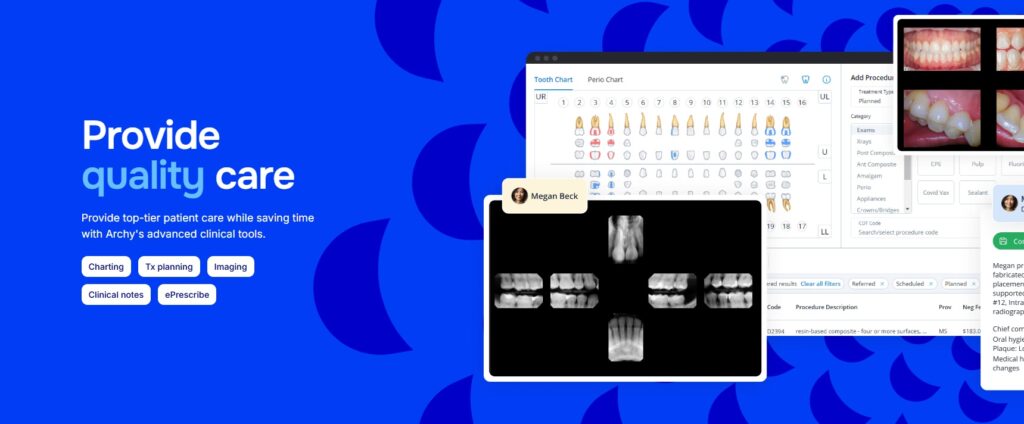
On Archy’s public clinical tools page and pricing materials, the company highlights charting, treatment planning, integrated imaging, clinical notes, and ePrescribe as built-in components of its platform.
At the platform level, Archy dental imaging software is positioned as a built-in imaging environment rather than an external add-on. Archy’s clinical tools page says users can choose any combination of x-rays or photos and compare them across dates and mounts to analyze changes over time, while its sensor compatibility page explains that the system supports a range of dental sensors and intraoral cameras through manufacturer-specific connection methods.
Technically, that matters because imaging is most efficient when capture, review, and patient context are handled close to the chart and treatment workflow, instead of forcing staff to jump into a separate ecosystem just to locate studies or compare historical views.
That is also why the phrase integrated dental imaging is more than a marketing label. Integration reduces workflow fragmentation at the chairside. When imaging is native to the practice platform, the provider can move more directly from image review to chart updates, treatment planning, clinical note creation, and patient communication.
Archy explicitly lists integrated imaging as part of its clinical tools and pricing lineup, and its comparison pages use the same feature as a point of differentiation against legacy competitors. In practical terms, native imaging improves continuity: fewer context switches, less duplicate navigation, and a stronger chance that the right image, note, and treatment decision stay connected inside one patient record.
The documentation side is represented by Archy dental charting software, which fits into Archy’s broader effort to simplify chairside data entry. The main site describes “smart charting” that records notes hands-free and in real time, and the clinical tools page adds that smart clinical notes can be linked to specific appointments, providers, or procedures, with customizable templates that transform form inputs into notes during appointments.
This is technically meaningful because charting quality is often constrained by time pressure. A charting system that ties note generation to appointment context and reusable templates can reduce documentation lag, improve consistency, and help clinicians finish records closer to the moment of care rather than reconstructing them later from memory.
This leads naturally to AI dental charting, where Archy appears to be combining templated documentation with AI-assisted capture and workflow support. The current Archy homepage presents Scribe as a capability that records notes hands-free and in real time, while the company’s AI page clarifies that some showcased AI features are live today and others remain in development. That distinction matters.
Based on Archy’s public materials, the reporting and verification AI tools are already available, while the broader AI vision is still expanding. Even so, the direction is clear: Archy is building toward a clinical environment in which documentation becomes faster, less manual, and more tightly embedded in the same intelligent platform that also supports operations and revenue workflows.
A particularly notable part of the clinical story is Archy’s partnership with Pearl. Archy states that FDA-cleared Pearl AI is available in its imaging suite, and the partnership announcement says Pearl’s Second Opinion is integrated within Archy’s native imaging platform.
According to those sources, the tool helps identify pathologies and non-pathologies and provides calibrated bone-level measurements and colored tooth parts; the announcement also says it can help visualize findings such as caries, bone loss, root abscesses, calculus, faulty restorations, impactions, crowns, and fillings for patients age 12 and older.
From a clinical informatics standpoint, this is significant because it pushes image interpretation support closer to the provider’s normal workflow and can strengthen both patient education and diagnostic communication without requiring a separate standalone AI application.
Taken together, Archy’s clinical layer is strongest when viewed as a continuity system. Imaging is connected to charting, charting is connected to notes, notes are connected to appointment context, and AI-enhanced review is being layered into the same environment rather than scattered across separate vendors.
That design does not replace clinical judgment, but it can reduce operational drag around care delivery, improve documentation discipline, and make the provider’s workflow feel more coherent from image capture to treatment discussion to record completion.
Patient Communication and Experience
Patient communication is no longer a soft, secondary layer in dental software. It is part of the operating system of the practice. If patients cannot confirm appointments easily, receive timely reminders, ask simple questions, or complete routine interactions without friction, the office pays for that breakdown through no-shows, lower collection rates, heavier phone volume, and a weaker overall experience.
Archy treats this function as a built-in platform capability rather than an external add-on, which is one of the clearest signs that it is designed for modern practice operations. Archy’s product pages describe built-in texting, two-way messaging, email marketing, AI-powered call summaries, integrated online scheduling, and communication automation aimed at keeping patients engaged while reducing staff workload.
At a category level, Archy dental patient communication software is best understood as a native engagement layer inside the same cloud system that also manages scheduling, charting, insurance, and payments.
Third-party software directories consistently describe Archy as a unified dental platform that includes patient communications alongside its core management tools, while Archy’s own site positions patient messaging as part of both the patient-experience and AI product stack.
That matters technically because communication becomes more useful when it shares context with live appointments, patient records, and billing events. Instead of sending generic outbound messages from a disconnected tool, the platform can tie reminders, updates, and outreach to actual workflow state inside the practice.
More broadly, dental patient communication works best when the system supports both automation and human responsiveness. Archy’s patient-experience page highlights automated texting, two-way texting, and email marketing, while its AI materials describe a communication agent that connects with patients through text, email, or chat using reminders and updates.
This is an important design choice. In real practice environments, communication cannot be purely one-directional. Offices need automation for scale, but they also need conversational flexibility when a patient replies, requests a change, asks a question, or needs clarification. A platform that combines outbound automation with two-way channels is better aligned with how patients actually interact with dental offices in the U.S. today.
That is where patient engagement dental software becomes a meaningful category label rather than a marketing phrase. Engagement is not just sending messages. It is creating a system in which patients can book more easily, respond more easily, and stay connected to the practice without unnecessary effort. Archy’s growth page says online scheduling is directly integrated into the platform and updates instantly in real time, and it states that 45% of online bookings happen after 8 p.m. It also says practices using Archy see 15 to 25 new online bookings per month through this channel. Operationally, these claims suggest that Archy is treating engagement as a continuous access problem: patients should be able to interact with the office when it is convenient for them, not only when staff are available to answer the phone. That is a strong example of patient experience serving both convenience and revenue performance at the same time.
The most visible mechanism inside that engagement layer is dental reminders and messaging. Archy’s communication pages and blog content highlight reminders, automated texts, follow-up messaging, and features aimed at reducing no-shows.
In one company post, Archy says practices can reduce no-shows by up to 20% using automated text reminders, personalized messages, consent tracking, no-show fees, and a waiting list. Another post explains text-to-pay reminders as a way to improve collections by making it easier for patients to complete payment from their phones.
Technically, this is important because reminder systems are most effective when they are event-linked and action-oriented. Appointment reminders reduce missed visits, follow-up messaging supports care continuity, and payment reminders shorten the path from balance visibility to collection. When all of those interactions live in the same platform, the practice reduces communication lag and lowers the number of manual outreach steps staff must manage each day.
A few technical advantages stand out here:
- Native communication tools can draw directly from scheduling and patient records, which improves relevance and timing.
- Two-way texting lowers friction compared with phone-only workflows and gives staff a faster way to manage simple patient interactions.
- AI-generated call summaries add a documentation layer that can help practices understand call reasons and staff performance without relying entirely on manual note-taking.
- Messaging tied to payments and scheduling turns communication from a generic outreach channel into an operational tool that directly affects attendance and collections.
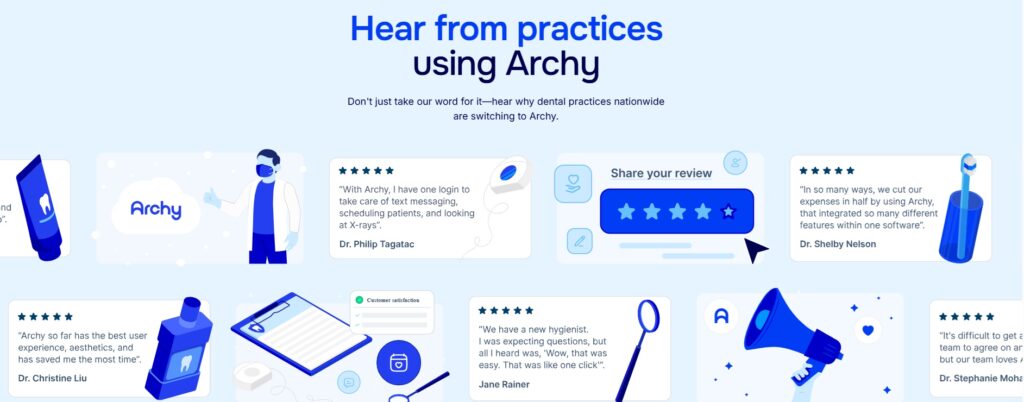
There is also a practical experience dimension that is easy to overlook. Archy customer testimonials mention the ability to text patients directly from the chart, which reinforces the idea that communication is embedded in the live patient context rather than isolated in a separate inbox or third-party service.
That kind of integration matters because it shortens response time and reduces staff switching costs. A reminder, follow-up, or clarification can happen right where the patient record is already open. In workflow terms, that is small but meaningful design efficiency.
Purchase and Conversion
When a dental practice evaluates new software, the buying decision is rarely based on feature lists alone. What matters is whether the platform is financially predictable, operationally adoptable, and realistically deployable without disrupting the business.
That is exactly where Archy tries to strengthen its case. Its public pricing and conversion pages are built around a familiar buyer journey: understand the package structure, estimate savings, book a walkthrough, and reduce fear around implementation by showing how the transition works. In other words, Archy is not only selling software functionality; it is selling a lower-friction path to replacement.
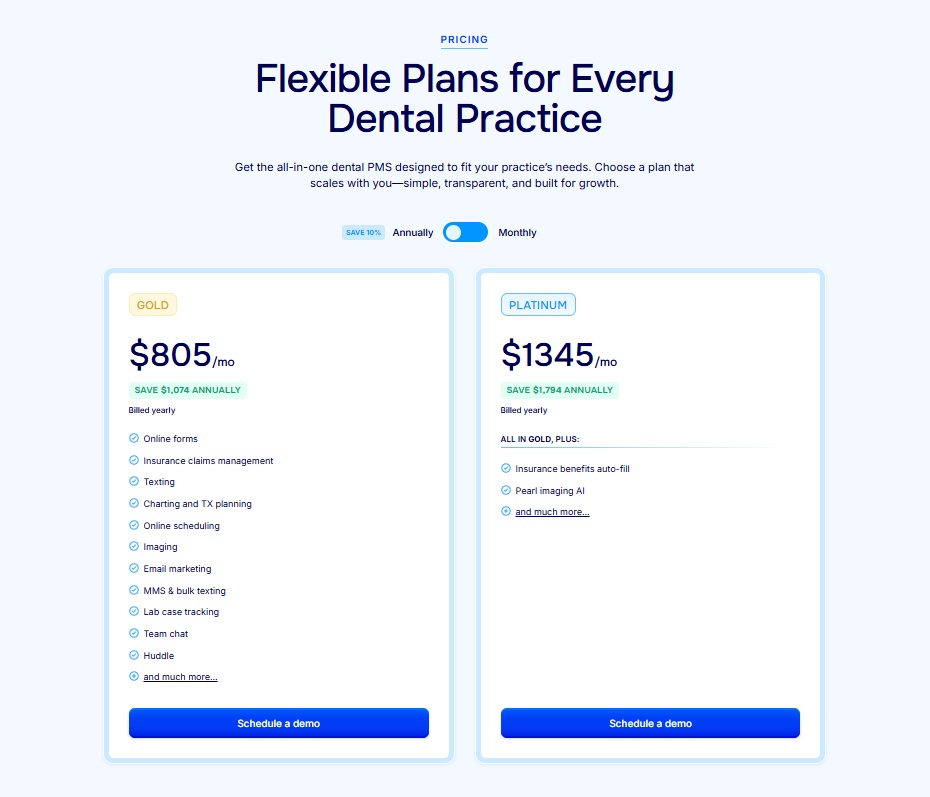
The first major conversion touchpoint is Archy dental software pricing. Archy’s pricing page says it offers “simple plans and simple pricing” for different practice needs, while also distinguishing between platform tiers and included capabilities.
The page indicates that some lower-tier plans remove extras such as ePrescribe and insurance claims management, which is important because it signals modular packaging rather than a single undifferentiated contract.
From a buying-process standpoint, that helps practices map software selection to actual operational complexity. A solo office, a growing group, and a more advanced organization may not need the same configuration on day one, so packaging flexibility becomes part of the product strategy rather than just a finance detail.
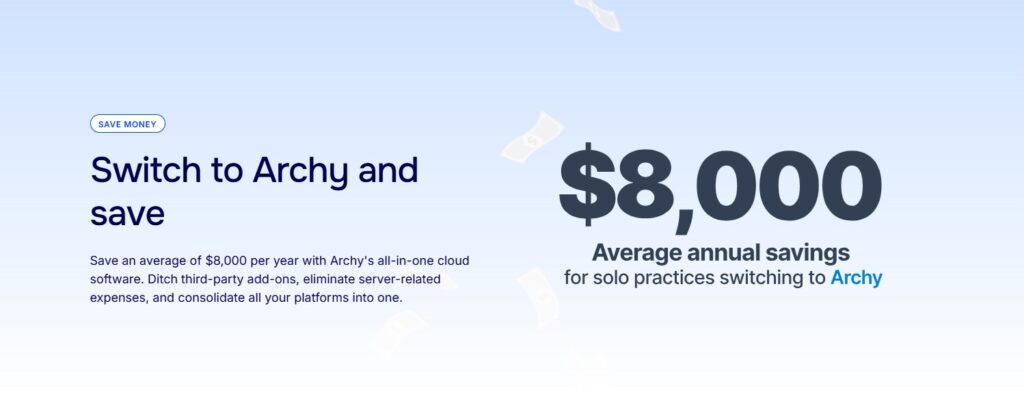
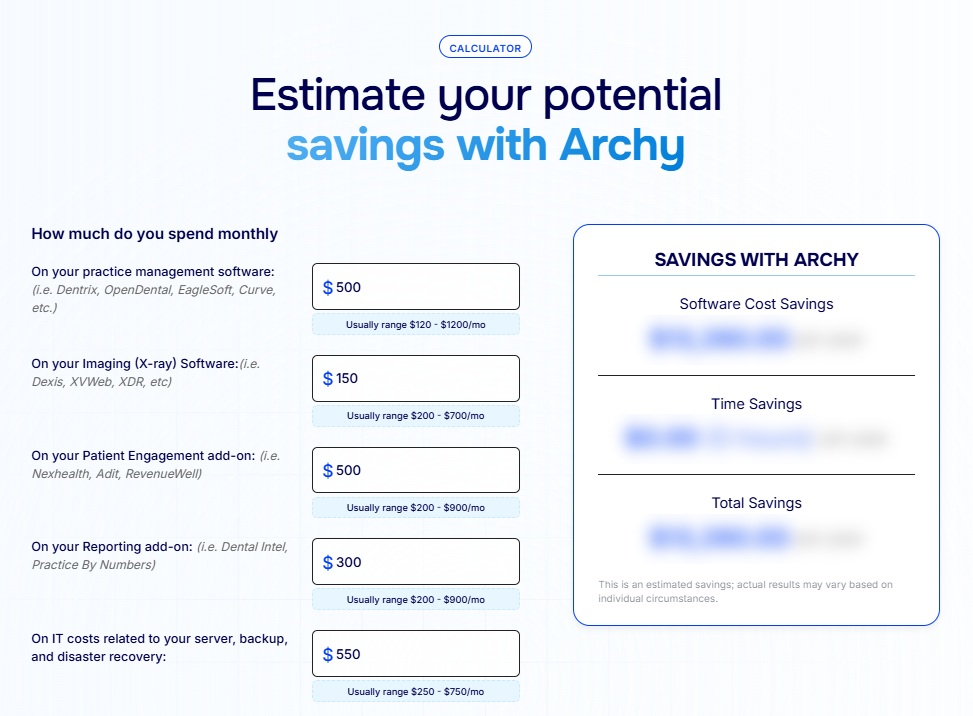
Closely related is Archy dental software cost. Archy’s own lead-generation pricing page claims practices switching to Archy save an average of $8,000 per year, while Software Advice currently lists pricing starting at $805 per month. Taken together, those sources suggest Archy’s cost positioning is built around consolidation economics: replace several separate tools with one platform, reduce redundant subscriptions, and lower operating overhead tied to legacy systems.
For a U.S. dental buyer, that framing is commercially effective because software budgets in dentistry are often fragmented across scheduling, communication, imaging access, claims, payments, reminders, and analytics. A product that can credibly compress that stack has a stronger value argument than one that competes only on base subscription price.
The evaluation stage is anchored by Archy dental software demo. Archy repeatedly pushes demo-driven conversion across its homepage, pricing flow, and campaign pages, with calls to “Get a Demo” and “Get Pricing” appearing as primary entry points.
That is a common SaaS sales pattern, but in Archy’s case it also reflects product complexity: this is software that touches operations, billing, imaging, communication, and reporting, so buyers usually need a guided walkthrough rather than a simple self-serve checkout. A demo in this context is doing several jobs at once.
It validates workflow fit, shows how the unified platform behaves in real use, frames the migration path, and supports ROI storytelling around saved time and reduced software sprawl.
Archy’s public campaign pages make that explicit by pairing demo booking with claims about time savings, easier learning, and practice transformation.
The last major barrier to purchase is switching risk, which is why dental software data migration is such a decisive topic in this category. Archy addresses that concern directly through its “Converting to Archy” page, a conversion checklist, and pricing flow language that emphasizes a “simple 4-step conversion process.”
The conversion checklist is especially useful because it gets very concrete: it shows that Archy can migrate a broad set of records and objects from platforms such as Dentrix, Eaglesoft, Open Dental, Curve, Denticon, Practiceworks, and others, including patient information, appointments, charting, clinical notes, fee schedules, insurance records, claims, pre-auths, EOBs, payments, and more.
That level of specificity is not just marketing reassurance. It is a technical buying signal. It tells prospects that implementation planning has been operationalized into a defined migration framework rather than treated as a vague post-sale promise.
A few things make Archy’s purchase-and-conversion story stronger than a generic software pitch:
- Its pricing structure appears tiered enough to support different practice sizes and needs.
- Its cost messaging is tied to replacement value and annual savings, not only sticker price.
- Its demo flow is central because the product is sold as an operational system, not a single-purpose tool.
- Its migration materials reduce perceived implementation risk by documenting what can and cannot be transferred.
What this section reveals is simple: Archy understands that conversion in dental software is emotional as much as technical. Buyers worry about cost, disruption, staff retraining, and data loss.
Archy’s public funnel is clearly designed to answer each of those anxieties in order: pricing for clarity, demo for confidence, migration for trust. That is a smart structure for selling replacement software in the U.S. dental market, where the decision to switch is often harder than the decision to buy.
Trust Signals
In dental software, trust is not built from branding alone. It comes from evidence that the system is stable, usable, well-supported, and broad enough to handle the real complexity of a practice. For Archy, the trust layer is shaped by two visible signals in particular: market-facing feedback and the depth of the platform itself.
That is why Archy dental software reviews and Archy dental software features work as the two most natural anchors for this section. Together, they answer the two buyer questions that matter most: “Can I trust this vendor?” and “Can this system actually do the job?”
The first trust signal is Archy dental software reviews. Current third-party review platforms show Archy with a 5.0 rating on both Software Advice and Capterra, based on the reviews presently listed there. Software Advice describes Archy as a unified cloud-based dental platform covering scheduling, patient communications, clinical charting, insurance verification, online payments, and team management.
Capterra shows the same 5.0 rating, lists the starting price at $805 per month, and highlights review sentiment around ease of use, support quality, and value. G2 also presents Archy as an all-in-one cloud-based platform focused on smooth, efficient, and profitable dental operations.
These external listings matter because they provide a credibility check outside the vendor’s own website. Even though the visible review volume is still relatively small, the available third-party feedback is consistently positive and aligns with Archy’s own product positioning.
The review content itself is also revealing. On Capterra, a recent reviewer described the transition to Archy as smooth and specifically praised user support, interface clarity, and the sense that customer feedback is actually incorporated into the product.
On Archy’s own customer stories page, multiple practices emphasize ease of learning, lower software costs after switching from older systems, and broad team adoption across both experienced staff and newer hires.
These are valuable trust markers because in practice-management software, trust is not only about uptime or compliance. It is also about whether a team can adopt the system without prolonged disruption and whether the vendor behaves like a responsive long-term partner after implementation.
The second trust signal is Archy dental software features. A platform earns confidence when it covers the workflows that practices actually depend on without forcing them into a patchwork of separate tools. Archy’s current pricing and product pages show a wide built-in feature set that spans:
- scheduling and appointment tools,
- new patient forms and consent forms,
- reporting and dashboards,
- lab case tracking,
- real-time insurance eligibility,
- insurance claim management,
- online and in-person payments,
- text-to-pay and patient wallet tools,
- patient portal and two-way texting,
- online scheduling and review capture,
- charting, treatment planning, and integrated imaging,
- clinical notes, ePrescribe, and optional Pearl imaging AI.
This breadth matters because feature completeness reduces dependency risk. If a practice has to rely on too many third-party plug-ins for core workflows, trust in the overall stack weakens because every integration point becomes another place where data, support responsibility, or workflow continuity can break down.
Archy’s strongest trust argument is therefore architectural: it is marketed as one cloud platform that replaces multiple systems, and the published feature set is broad enough to make that claim credible. Software Advice, Capterra, and G2 all reinforce that same all-in-one characterization, which adds consistency across independent sources.
There is also a technical trust dimension in Archy’s cloud positioning. The homepage states that the platform keeps practices connected, secure, and up to date, with automatic backups, access from anywhere, and HIPAA-compliant protection, while explicitly saying there are no servers or maintenance required in the office.
Its comparison pages against Dentrix, Eaglesoft, and Open Dental repeatedly use cloud architecture, integrated imaging, patient communication, reporting, payroll or team tools, and reduced add-on dependence as proof points for why Archy is more modern than legacy alternatives.
Even though those comparison pages are vendor-authored and should be read with that in mind, they still help clarify the specific product areas where Archy wants buyers to place their confidence: lower infrastructure burden, broader built-in functionality, and a more unified operating environment.
Taken together, the trust case for Archy is fairly clear. External reviews suggest strong early customer satisfaction. Customer stories point to easier adoption and lower software sprawl after switching. The published feature set is broad enough to support the all-in-one claim.
And the cloud-native platform story gives buyers a rational basis for trusting the system as a long-term operational replacement rather than a narrow point solution. In a category where practices are often cautious about migration risk, those combined signals matter more than marketing language alone.
Comparison and Alternative Searches
Comparison-focused search behavior is one of the clearest signs of serious purchase intent in dental software. Once a practice moves beyond “what is this platform?” and starts searching for alternatives, the evaluation becomes more technical, more cost-sensitive, and much more operational. That is exactly why queries like Archy dental software alternatives, Archy vs Dentrix, Archy vs Eaglesoft, Archy vs Open Dental, and Archy dental software for small practices matter so much.
They reflect the moment when a buyer is no longer browsing category options casually, but actively testing replacement risk, workflow fit, migration difficulty, and long-term value.
The broadest of these searches is Archy dental software alternatives. Current third-party comparison sources show that Archy is most often evaluated against platforms such as Curve Dental, CareStack, Dentrix Ascend, Open Dental, and other cloud or practice-management systems in the dental category.
G2 currently lists Carepatron, Curve Dental, and CareStack among the top alternatives, while Capterra’s category and profile pages place Archy in the broader dental software buying set alongside other operational and clinical platforms.
This matters because “alternatives” searches are rarely about feature parity alone. They usually signal that the practice is trying to compare software philosophies: all-in-one cloud consolidation versus modular legacy stacks, native tools versus add-ons, and modern workflow automation versus older front-desk-centered systems.
The most commercially important comparison query is probably Archy vs Dentrix. Archy’s own Dentrix comparison page frames the choice around built-in functionality, cloud access, imaging, reporting, insurance claims processing, EOB handling, and employee-management capabilities, while customer quotes on Archy’s homepage and review pages explicitly mention moving away from Dentrix because of limited cloud access and heavier operational friction.
Even allowing for vendor bias on comparison pages, the structure of the comparison is revealing: Archy wants buyers to see the decision not as “new software versus old software,” but as “one connected cloud platform versus a legacy ecosystem that often requires more fragmentation and more manual coordination.” That framing is central to how Archy competes in the U.S. market.
A closely related query is Archy vs Eaglesoft. Archy’s Eaglesoft comparison page uses very similar positioning, emphasizing that imaging, patient communication, and charting are built directly into the platform and claiming that practices can save staff significant time each month by switching.
The consistency of that message matters. It suggests that Archy sees Eaglesoft as another legacy benchmark from which it can differentiate on cloud delivery, fewer disconnected tools, and broader out-of-the-box workflow coverage. The homepage testimonial language reinforces the same idea by explicitly grouping Eaglesoft and Dentrix together as systems that lacked the mobile, cloud-accessible experience Archy users wanted.
The query Archy vs Open Dental points to a slightly different comparison dynamic. Open Dental is often evaluated favorably by practices that want flexibility and lower base software costs, so Archy’s comparison page responds by leaning heavily into “true one-stop solution in the cloud,” with built-in imaging, patient communication, charting, and even payroll-related functions.
In other words, this comparison is less about “modernizing from legacy software” and more about the tradeoff between a highly configurable practice-management system and a more unified all-in-one platform. For buyers, that is an important distinction. Open Dental comparisons often revolve around whether the practice prefers modular control and customization, or a more centralized platform that minimizes the need for separate integrations and vendor coordination.
The last important intent signal is Archy dental software for small practices. This query is especially relevant because software replacement decisions vary sharply by office size. Small practices usually care most about ease of adoption, predictable cost, fewer vendors, simpler support, and lower IT burden. Archy’s public pricing page offers tiered plans, and Capterra currently lists entry pricing from $805 per month, which suggests a packaging structure that can appeal to smaller organizations if the all-in-one value offsets what they would otherwise spend on multiple separate systems.
For small practices, the comparison is often less about maximum enterprise complexity and more about operational simplicity: one login, one platform, one support relationship, and fewer moving parts across scheduling, payments, forms, communication, and charting.
A few technical themes appear again and again across these alternative and comparison searches:
- Archy consistently competes on cloud-native delivery and reduced dependence on in-office servers.
- It differentiates itself through built-in breadth, especially across imaging, communication, charting, reporting, payments, and insurance workflows.
- It tries to lower switching fear by documenting onboarding and migration pathways from Dentrix, Eaglesoft, Open Dental, Denticon, Curve, CareStack, and other systems.
- Third-party comparison ecosystems place it in the same consideration set as established dental PMS and newer cloud competitors, which confirms that buyers already see it as a legitimate alternative rather than a niche product.
Taken together, these comparison queries reveal the real competitive identity of Archy. It is not trying to win by being just another dental software product with a slightly different interface. It is trying to win by reframing the buying decision around consolidation, cloud access, and workflow unification.
That is why comparison searches are so valuable: they expose the exact moment when the market stops asking what Archy is and starts asking whether it is better than the systems practices already know.
What is Archy Dental Software?
Archy is a cloud-based all-in-one dental practice management platform that combines scheduling, patient communication, charting, insurance workflows, payments, reporting, and imaging in one system. It is designed to replace multiple separate tools with a single dental office platform.
Is Archy a cloud-based dental software?
Yes. Archy is marketed as cloud-based dental software, which means practices can run core workflows without relying on traditional in-office server infrastructure.
What does Archy Dental Software do?
Archy helps dental practices manage daily operations such as scheduling, online forms, insurance verification, claims, payments, reporting, imaging, and patient messaging. Its goal is to centralize both administrative and clinical workflows in one platform.
How much does Archy Dental Software cost?
Archy’s public pricing page shows plan-based pricing, while third-party listings currently show pricing starting at about $805 per month. Actual cost can vary by plan, office count, and claim volume.
Does Archy offer a demo?
Yes. Archy offers personalized one-on-one demos through its demo pages, where practices can see the platform and discuss fit, pricing, and migration.
Is Archy easy to switch to from another dental software?
Archy says it uses a simple 4-step conversion process and provides migration resources for practices moving from other systems. Its conversion checklist shows support for transferring a wide range of patient, appointment, charting, insurance, and financial data.
Can Archy migrate data from Dentrix, Eaglesoft, or Open Dental?
Yes. Archy’s conversion checklist specifically includes Dentrix, Eaglesoft, and Open Dental among the systems it supports for data transfer.
Does Archy support insurance verification?
Yes. Archy includes real-time insurance verification and also supports scheduled automatic eligibility checks before appointments.
Does Archy handle insurance claims?
Yes. Archy includes insurance claim management and says it can automatically draft claims after appointments, with support for attachments and centralized processing.
Does Archy include patient communication tools?
Yes. Archy includes patient communication features such as text messaging, reminders, and communication workflows tied to appointments and collections.
Does Archy support online payments?
Yes. Archy offers online and in-person payment features and positions them as part of its collections and payment workflow.
Does Archy include imaging and charting?
Yes. Archy includes built-in imaging and charting tools, along with treatment planning and clinical notes.
Does Archy use AI?
Yes. Archy has introduced AI-focused features under “Archy Intelligence,” including tools for billing, verification, charting, reporting, and patient communication. Its imaging suite also includes FDA-cleared Pearl AI capabilities.
Is Archy HIPAA compliant?
Third-party listings identify Archy as HIPAA compliant, and Archy’s public materials emphasize security and cloud-based protection for dental practices.
What are the best alternatives to Archy Dental Software?
Common alternatives mentioned across comparison and review sites include Dentrix, Eaglesoft, Open Dental, Curve Dental, and CareStack. The best choice depends on whether a practice prioritizes cloud-native simplicity, customization, pricing transparency, or legacy workflow familiarity.
How does Archy compare to Dentrix?
Archy positions itself as a more modern cloud-based alternative to Dentrix, with built-in imaging, reporting, claims processing, and broader all-in-one functionality. Dentrix remains a major legacy benchmark, but Archy competes on consolidation and easier cloud access.
How does Archy compare to Eaglesoft?
Archy presents itself as a cloud-first alternative to Eaglesoft with built-in imaging, patient communication, and charting. The main comparison is typically between legacy desktop-style workflow and a more unified cloud platform.
How does Archy compare to Open Dental?
Archy competes with Open Dental by emphasizing a one-stop cloud platform with more native built-in tools, while Open Dental is often preferred by practices that want more customization and data-control flexibility.
Is Archy Dental Software well reviewed?
Yes, based on currently visible third-party listings, Archy has strong ratings, including 5.0 on Capterra and Software Advice. Review counts are still relatively limited, so the ratings are promising but early.
Who is Archy Dental Software best for?
Archy is best suited for dental practices that want one cloud platform for operations, clinical workflows, communication, payments, and insurance tasks instead of managing multiple separate tools. Its pricing and tier structure also suggest it can serve both growing and multi-office practices